
How to Choose The Best Games for Your Library in 2026 (And 5 To Get You Started)

The board and card game renaissance has been in full swing over the last decade, and with schools aiming to roll back how much time kids spend on screens, it is the perfect time to build up a great library of games for learners. According to a 2024 Pew Research study, 85 percent of teens play games regularly, and 72 percent report that they play games to connect socially.
Our criteria comes down to a few simple criteria:
- Beneficial – Does the game build key skills?
- Accessible – Is the game easy to learn and teach?
- Flexible – Can the game be adapted for multiple purposes or topics?
- Engaging – Do students ask to play the game again and again?
With that in mind, we’ve identified five fantastic games for any K-12 or public library.
1. Just One – A Simple Word Game that is Surprisingly Complex

The premise of Just One sounds almost too straightforward to be any fun: a player is trying to guess a secret word, and all other players can only give them a one-word clue. The rub? If any two players give the SAME clue, they cancel out and that clue is gone. If the word is princess, do you provide some famous examples? A castle? Just One lets students flex those critical thinking muscles and it works with class or developmental vocabulary too.
2. Gamestormers – Creative Storytelling Set to Popular Themes

Plenty of times we hear people say, “I’m not creative.” Often, they simply need a creative stimulus. In Gamestormers, players are given a collection of cards from popular storylines, including fantasy, sci fi, high seas, and horror. They weave five of their cards together to create a cohesive narrative, and they tell their tale to the judge for the round, hoping to earn their vote. Students love the opportunity to work in humor, twist endings, and their own flourishes to the storytelling mechanic, and the game is a quick teach as well.
3. Pictures – Using Manipulatives to Communicate Complex Ideas

Imagine trying to represent a beautiful seaside cabin using only sticks and stones. Or a spider weaving a web using only wooden blocks. In Pictures, players are secretly assigned one image across a grid of images, and they have small kits to try and capture their visual – shoelaces, small colored cubes, graphics on cards, and the aforementioned wood blocks and sticks/stones. The creative constraint of few colors, items, or shapes makes the game a unique challenge, and librarians could sub in endless visuals or words to make the game a new experience too.
4. Doomscroll – Social Media Literacy Through Strategic Card Game
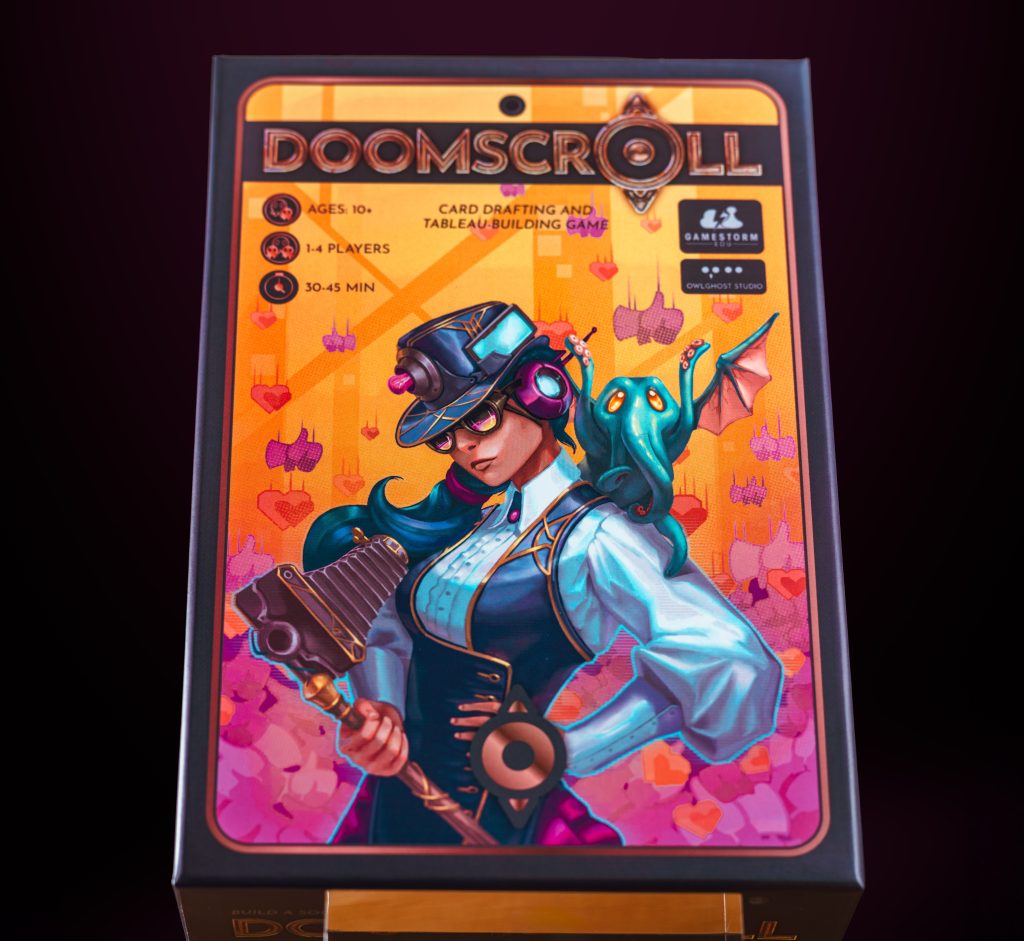
Many educational games fall into the trap of being too heavy-handed in trying to teach a specific concept and forget to make the game engaging first. Doomscroll flips the script by subtly teaching social media literacy by putting players in the drivers seats of the social media company, letting them try to sell ads by building an addictive feed through not-so-moral means. After students use tactics reflective of how social media works today, librarians have a great opportunity to debrief with students about their own habits online and what they will notice moving forward.
5. Green Team Wins – A Clever Way to Build Community

Maybe it is your first board game club meeting. Maybe it’s the first week of school. Regardless, you want kids talking, connecting, and finding common ground and sharing their passions. In Green Team Wins, cards prompt either a “this or that”, “choice of 3”, or “free response” answer, and the player’s goal is to provide the answer that will be most popular among all players. For instance, would most people prefer Oreos, M&Ms, or cookie dough on vanilla ice cream? The best part of the game is the conversation that happens after students reveal their answer – there are plenty of laughs, friendly arguments, and bragging rights!